
From Backend to Frontend: Python Full Stack Explained
By Shweta | 30th July 2025
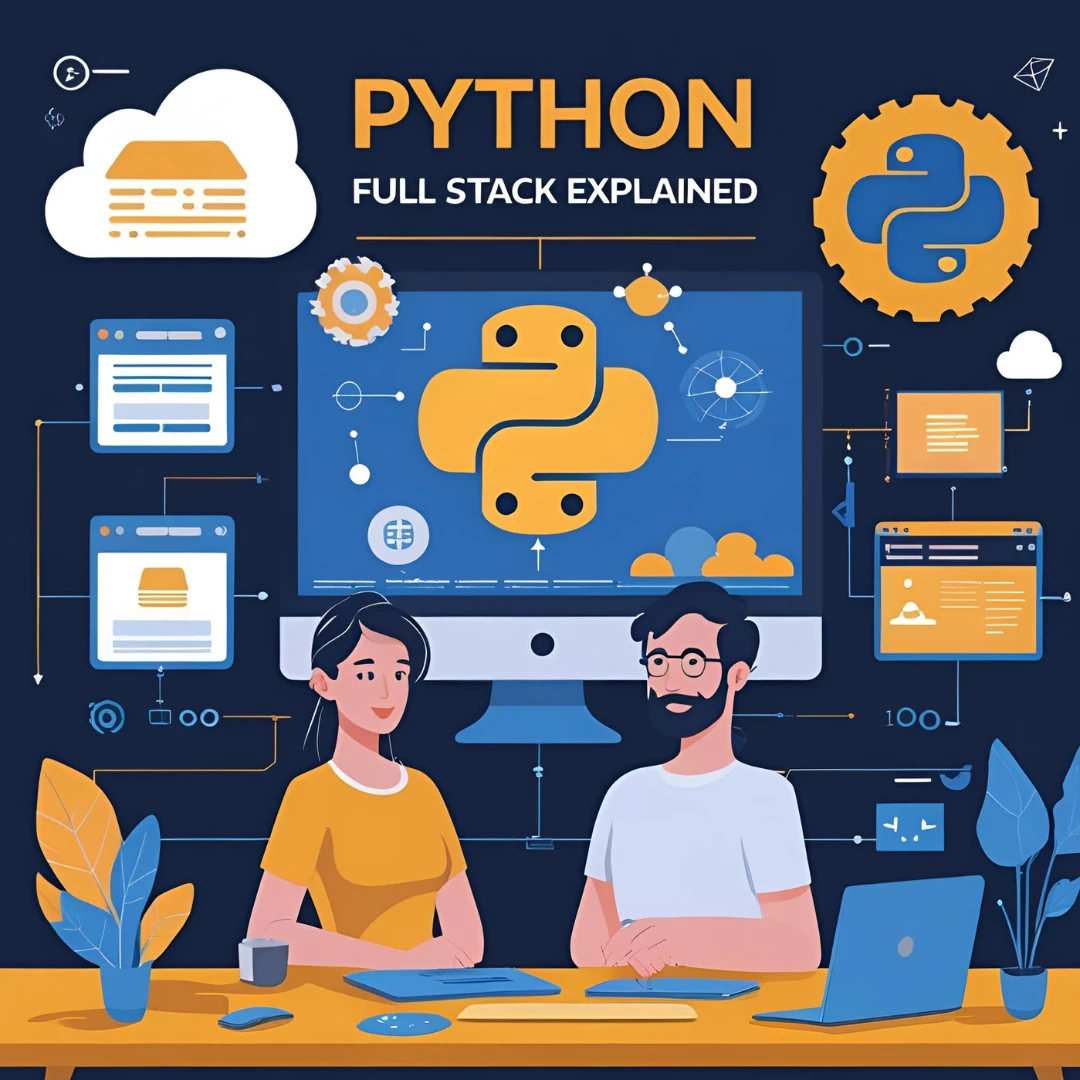
Your Complete Guide to Becoming a Full Stack Developer with Python at Cloud Institution
In today’s fast-paced tech world, companies—especially startups and small businesses—are looking for developers who can build and manage both the frontend and backend of web applications. These professionals are called Full Stack Developers.
Among various stacks, Python Full Stack is becoming increasingly popular due to its simplicity, versatility, and powerful frameworks. But what does being a Python Full Stack developer really mean? What technologies do you need to learn? And how can you become one?
In this blog, we’ll break it down from backend to frontend, explaining each layer of the Python Full Stack and how you can master it at Cloud Institution—a platform designed to help you build real-world, job-ready skills
What is Full Stack Development?
Full Stack Development means working with both:
Frontend (Client-side): What users see and interact with (UI/UX)
Backend (Server-side): Logic, databases, and APIs that power the frontend
A Python Full Stack Developer uses Python for backend development and combines it with frontend technologies like HTML, CSS, JavaScript, and modern frameworks like React or Vue.
At Cloud Institution, you learn all of these layers with hands-on projects, real startup use cases, and deployment experience.
The Backend: Python, Django, and Flask
Let’s start from the server-side—this is where the core business logic lives.
Python
Python is known for being clean, readable, and beginner-friendly, yet powerful enough to build scalable systems.
You’ll learn:
Python syntax, data structures, OOP
File handling, error management
Working with JSON, XML, and APIs
Django (The Big Gun)
Django is a high-level Python web framework that allows rapid development.
What you’ll build with Django:
Dynamic websites
Admin panels
APIs using Django REST Framework (DRF)
Secure login and session management
Flask (The Lightweight Hero)
Flask is perfect for microservices or lightweight apps.
You’ll use Flask to:
Create REST APIs
Integrate with frontends using Jinja2
Build chatbot interfaces or automation tools
Cloud Institution Learning Highlight:
Build a RESTful API using Flask and connect it to a React frontend to create a real-time chat application.
The Database Layer
You’ll need to store, retrieve, and manage data. At Cloud Institution, we train you in:
Relational Databases: PostgreSQL, MySQL
NoSQL Databases: MongoDB
ORMs: Django ORM and SQLAlchemy
You’ll learn how to:
Design database schemas
Write complex queries
Optimize performance for real-world data loads
Project Example:
Build a blogging platform where users can register, post content, like, and comment. Store user data securely in PostgreSQL.
The Frontend: HTML to React
Now, let’s move to the client side—the part users see and interact with.
HTML & CSS
These are the foundational building blocks of any website.
You’ll learn:
HTML5 semantics
CSS3 styling
Responsive design using Flexbox and Grid
Bootstrap & Tailwind CSS
Speed up your UI development with frameworks.
Create modern, mobile-first layouts
Use prebuilt components like navbars, modals, buttons
JavaScript
Make your frontend interactive.
You’ll cover:
JS syntax, DOM manipulation
ES6 features like arrow functions, promises, async/await
Form validation and fetch API calls
React.js
The most in-demand frontend library today.
At Cloud Institution, you’ll master:
JSX, props, state, hooks
Component-based architecture
Routing with React Router
Consuming REST APIs with Axios or Fetch
Capstone Project:
Build a real-time dashboard where users can log in, view analytics, and update profiles using React (frontend) + Django REST API (backend).
The DevOps Layer (Deployment & Hosting)
What’s the point of building an app if it never goes live?
We teach you how to:
Host applications on Heroku, AWS, or Render
Use Git and GitHub for version control
Automate deployments using GitHub Actions
Containerize apps with Docker
DevOps Project:
Containerize your full stack application and deploy it on AWS EC2 using NGINX and Docker Compose.
Why Learn Python Full Stack at Cloud Institution?
At Cloud Institution, we’ve designed our Python Full Stack course with real-world startups and job-readiness in mind. Here’s what makes us different:
Project-Based Learning
Build 5+ real-world apps from scratch
Learn how to debug, refactor, and optimize
Startup-Centric Curriculum
Build MVPs quickly, iterate fast
Learn how to scale apps and add features in production
Hands-on Deployment
Deploy every project to the cloud
Practice with CI/CD tools, Docker, and NGINX
Job & Freelance Support
Portfolio and GitHub review
Resume building and mock interviews
Freelancing projects and job referrals
How You’ll Learn: Structured Roadmap
| Month | Topics Covered |
|---|---|
| Month 1 | Python Basics, Django, HTML/CSS |
| Month 2 | JavaScript, Bootstrap, React |
| Month 3 | APIs, Authentication, Database Integration |
| Month 4 | Projects, Docker, CI/CD, AWS Hosting |
Final Capstone Projects You’ll Build
Blogging Platform – Full CRUD with authentication
Task Manager SaaS App – React frontend, Django backend
Video Streaming Site Clone – With payment integration
AI Chatbot Integration – Using Flask + OpenAI API
All projects are deployed, documented, and added to your portfolio.
Start Learning at Cloud Institution Today
Visit: https://cloudinstitution.com/blog
Enroll in Python Full Stack Training
Build startup-level apps and become job-ready in 3–4 months